
How Much Does It Cost to Finish a Basement in Toronto? 2026 Price Guide

How much should you budget to finish or remodel a basement in Toronto? A basement renovation can start at approximately $35,000 for a finished family space, while a premium finished basement with a bathroom, wet bar and custom millwork generally ranges from $75,000 to $120,000. A full legal rental suite can cost $150,000 or more.
The final price depends on much more than square footage. Basement size, existing conditions, layout, waterproofing, ceiling height, plumbing, electrical work, finishes and the intended use of the space can all affect the budget.
Understanding these variables early makes it easier to establish a realistic budget and decide where your investment will have the greatest effect.
What Is the Average Cost of a Basement Renovation in Toronto?
The average cost of a basement renovation is difficult to reduce to one meaningful number because basement projects vary considerably in scope.
Based on our current Toronto basement renovation pricing, homeowners can use these figures as preliminary benchmarks:
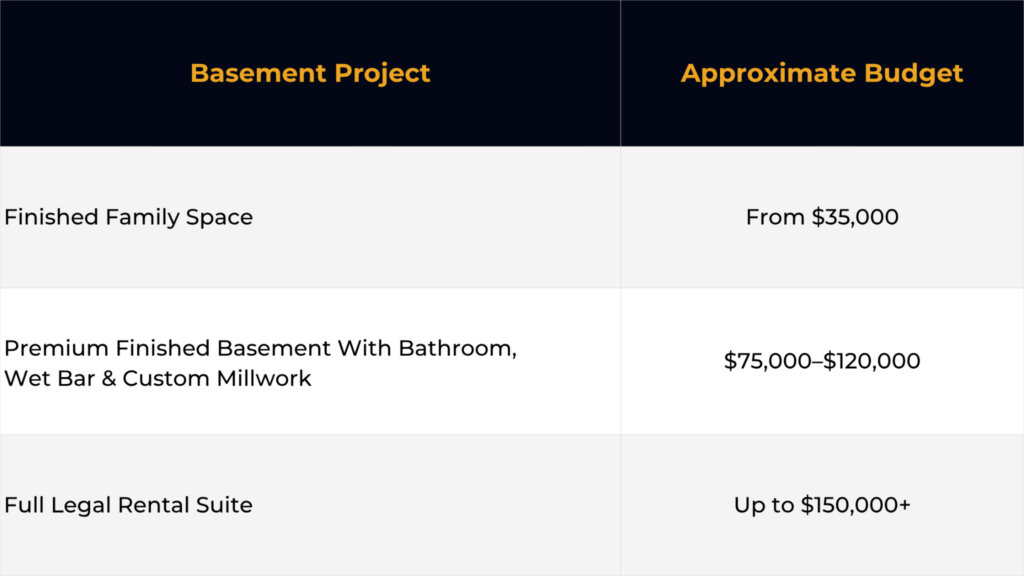
These are planning ranges rather than universal prices. A straightforward family room is fundamentally different from a basement containing a bathroom, kitchen, laundry area, separate entrance and the systems required for an independent dwelling.
A site assessment and defined project scope provide a much more useful budget than an industry-wide average.
How Much Does It Cost to Finish a Basement?
When homeowners ask how much a basement finish costs, it is important to first define what finishing includes.
Finishing an unfinished basement generally means turning the existing lower level into comfortable, functional living space. The work may include:
- Framing and insulation
- Drywall and ceilings
- Flooring
- Electrical work and lighting
- Heating, ventilation and air conditioning (HVAC) adjustments
- Painting
- Interior doors, trim and baseboards
A remodel can involve more substantial changes to an existing finished basement, while a full renovation may introduce new rooms, plumbing, custom features or major layout changes.
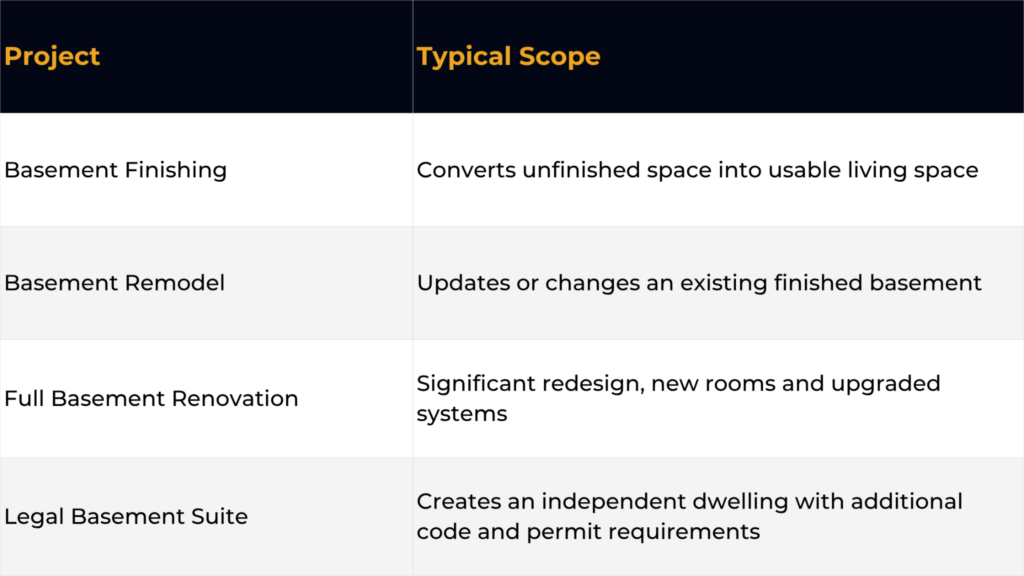
Bathrooms, kitchens, bars, structural modifications and custom millwork can quickly move a project beyond a basic finish.
Basement Renovation Cost Per Square Foot
Cost per square foot can be useful during early planning, but it should not be treated as a reliable quotation method.
Basement costs are not distributed evenly across the floor area. An 800-square-foot open recreation room may require relatively straightforward finishing, while another basement of exactly the same size could contain a bathroom, kitchenette, laundry area, custom bar and built-in storage.
The second project concentrates significantly more plumbing, electrical, cabinetry and finishing work into the same footprint.
For this reason, we recommend using square footage as one budgeting consideration rather than multiplying the basement area by a generic rate.
How Much Does It Cost to Finish a Basement by Size?
Basement size matters because larger spaces generally require more framing, drywall, flooring, lighting and labour. However, size alone cannot determine the final price.
A 500-square-foot basement with extensive plumbing and custom cabinetry can cost more than a 1,000-square-foot basement designed primarily as an open family room.
When estimating common basement sizes such as 500, 750, 1,000 or 1,200 square feet, we consider the area alongside the layout, existing conditions and features being added. Our broader benchmarks of approximately $35,000 for a finished family space, $75,000-$120,000 for a premium finished basement and up to $150,000+ for a legal rental suite provide a more useful starting point until the project scope is defined.
What Affects the Cost of a Basement Remodel?
If you are wondering how much a basement remodel costs, the answer largely depends on what needs to change within the existing space.
Size and Existing Condition
An unfinished, dry basement with suitable ceiling height presents a different starting point from a space requiring demolition, water remediation or replacement of existing systems.
Basement Layout
Open layouts usually involve fewer partitions, doors and specialized systems. Creating bedrooms, bathrooms, storage rooms, offices and other separate areas adds materials and labour.
Bathroom Addition
A basement bathroom can add plumbing, waterproofing, tile, ventilation, electrical work, fixtures and cabinetry. Its location relative to existing drainage and plumbing can also influence complexity.
Kitchen, Wet Bar or Kitchenette
Cabinetry, countertops, sinks, appliances, electrical circuits and plumbing increase the scope. Custom millwork can further affect the finish level and budget.
Flooring and Interior Finishes
Flooring, tile, lighting, doors, trim, plumbing fixtures and other selections can range from practical standard materials to premium finishes.
Custom Millwork and Built-Ins
Entertainment units, bars, shelving, storage, fireplace surrounds and custom cabinetry can make a basement significantly more functional, but they also require additional design, fabrication and installation.
Electrical, Plumbing and HVAC
Adding or relocating electrical, plumbing and HVAC systems can increase labour and coordination requirements, particularly when creating bathrooms, kitchens or separate living areas.
Waterproofing and Moisture Problems
Moisture should be addressed before new walls, flooring and cabinetry conceal the underlying condition. Proper waterproofing and drainage can increase the initial scope but help protect the finished space.
Ceiling Height and Structural Work
Older Toronto basements may have limited ceiling height. Underpinning or other structural work should be treated as a separate major scope rather than being assumed within a normal basement finishing budget.
What Does a Basement Renovation Budget Include?
A complete renovation estimate should account for more than visible finishes.
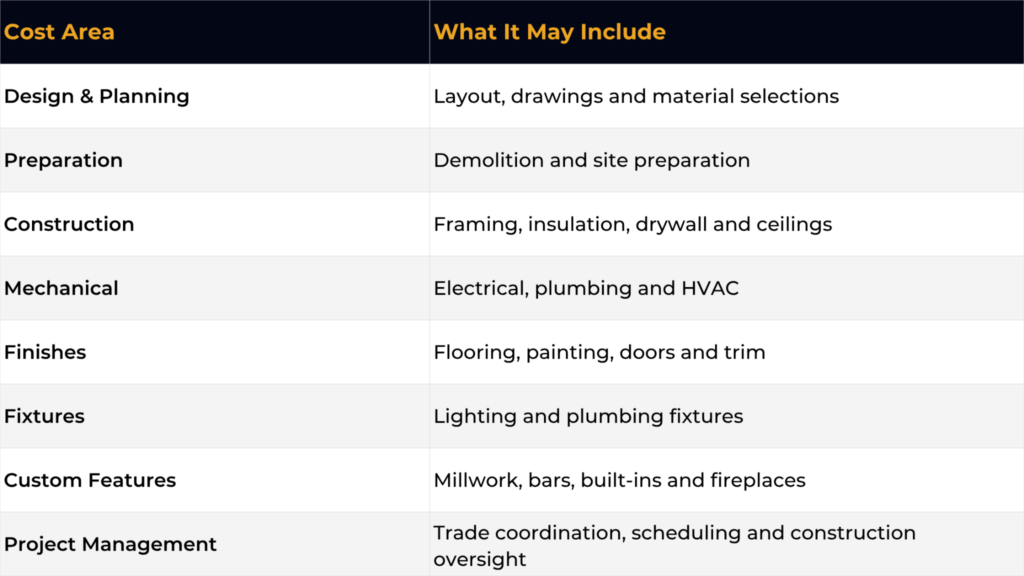
Looking at the complete scope makes it easier to compare estimates accurately instead of choosing based only on the lowest headline price.
How Much Does Adding a Bathroom to a Basement Cost?
There is no single reliable price for adding a basement bathroom because the existing conditions have a substantial impact.
Important factors include whether plumbing rough-ins already exist, the location of the bathroom, drainage requirements, shower or bathtub selection, tile coverage, vanity and fixture choices, ventilation and electrical requirements.
For budgeting purposes, the bathroom should be planned early rather than treated as a late addition. Our $75,000-$120,000 premium basement benchmark, for example, applies to projects that may include a bathroom along with a wet bar and custom millwork.
Does a Basement Renovation Need a Permit in Toronto?
Not every basement finishing project requires the same permits.
According to the City of Toronto, a building permit is required when basement work includes certain structural or material alterations, new or modified heating or plumbing systems, excavation, underpinning, a new basement entrance or an additional dwelling unit. Straightforward basement finishing without those elements may not require a building permit.
For secondary suites, the City’s 2026 fee schedule lists interior alterations for applicable Group C residential work at $11.53 per square metre, in addition to other applicable fees. The City also has specific procedures for related mechanical, plumbing and drain permits.
Permit requirements should always be confirmed for the actual project scope before construction begins.
Finished Basement vs. Legal Basement Suite: How Do Costs Compare?
A finished basement and a legal basement suite serve different purposes.
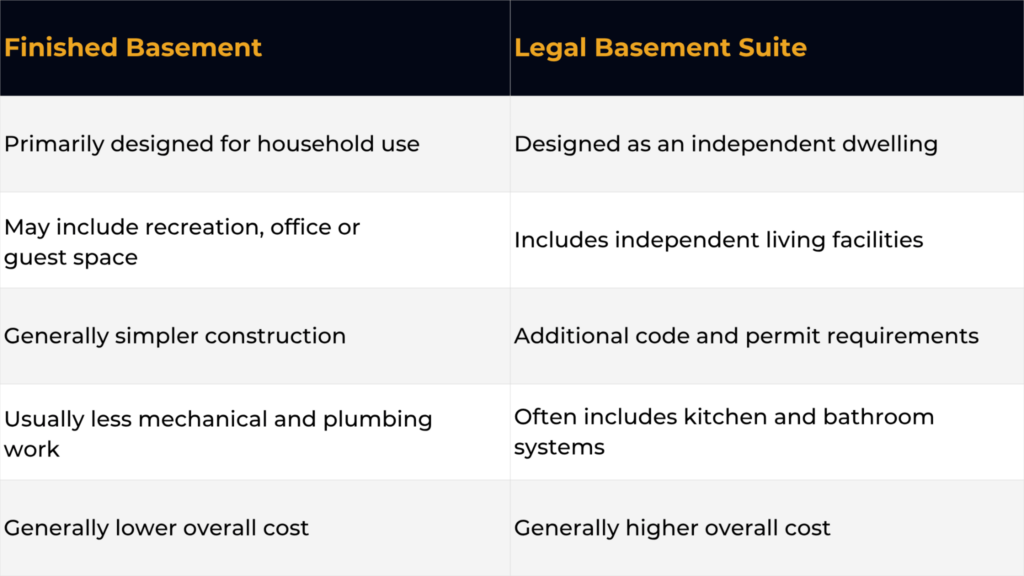
We design finished basements for uses such as family rooms, theatres, gyms, offices and guest areas, as well as legal basement apartments that require additional planning, approvals and construction.
That additional scope helps explain why a legal suite can approach or exceed $150,000 while a simpler finished family space may begin around $35,000.
Where Is It Worth Spending More in a Basement Renovation?
A larger budget does not need to mean upgrading every visible finish. Some investments can have a greater effect on comfort, functionality and longevity.
Prioritize moisture protection before covering walls and floors. Invest in appropriate insulation so the basement feels integrated with the rest of the home. Plan lighting carefully where natural light is limited, and select flooring suited to below-grade conditions. If improvements are also needed upstairs, including the basement in a complete home renovation in Toronto can help create consistent finishes, better connections between floors, and a more efficient construction plan.
Bathrooms and plumbing should also be coordinated early. Finally, thoughtful storage and custom millwork can make awkward corners and limited wall space considerably more useful.
How to Set a Realistic Basement Renovation Budget
A realistic budget starts with the intended use of the basement, not a target price per square foot.
- Decide how you want to use the finished space.
- Assess the basement’s existing condition.
- Separate essential features from optional upgrades.
- Establish the desired finish level early.
- Identify plumbing, electrical and structural requirements.
- Keep a contingency for conditions discovered during construction.
- Compare detailed scopes rather than total prices alone.
These steps make it easier to determine where to spend, where to simplify and which features should be incorporated from the beginning.
Why Design and Construction Planning Matter to the Final Cost
Early planning allows the design and construction scope to develop together.
Our basement renovation process can include assessment of existing conditions, concept development, construction drawings, custom millwork details, fixture specifications, three-dimensional (3D) renderings, quotations, permits and construction.
This coordination helps establish what the renovation actually includes, which choices have the greatest budget impact, where structural or mechanical work may be required and which materials fit the overall budget before construction begins.
Start Planning Your Basement Renovation With Bianco
The cost of a basement renovation depends on much more than its square footage. Existing conditions, layout, mechanical requirements, finish level and the features you want all shape the final budget.
At Bianco Design & Build, we can assess your basement, develop a coordinated design and prepare a detailed scope and quotation based on your property and goals.
Book a Consultation to start planning your basement renovation in Toronto.
Frequently Asked Questions
1. What is the average cost of a basement renovation in Toronto?
Our current basement renovation pricing starts at approximately $35,000 for a finished family space. Premium basements with a bathroom, wet bar and custom millwork generally range from $75,000 to $120,000, while full legal rental suites can reach $150,000+.
2. How much does it cost to finish a basement?
A straightforward finished family space may start around $35,000. Bathrooms, custom cabinetry, wet bars, kitchens, structural work and premium finishes can increase the total considerably.
3. How much does it cost to finish a 1,000 sq. ft. basement?
A 1,000-square-foot basement does not have a reliable fixed price based on area alone. Layout, bathrooms, plumbing, waterproofing, finish level and structural requirements are more useful indicators of final cost.
4. How much does a basement remodel cost per square foot?
Cost per square foot can provide an early reference, but it can be misleading for basements because expensive features such as bathrooms, kitchens and custom millwork may be concentrated within a relatively small area.
5. What is the most expensive part of finishing a basement?
There is no universal answer. Structural work, underpinning, waterproofing, bathrooms, kitchens and extensive custom millwork are among the elements that can have the greatest effect on a basement renovation budget.
6. Does adding a bathroom increase basement renovation costs?
Yes. A bathroom adds plumbing, drainage, waterproofing, ventilation, electrical work, fixtures, tile and finishing requirements.
7. Is it cheaper to finish a basement or build an addition?
Finishing existing space can involve less new construction than building an addition, but the comparison depends on the basement’s condition. Underpinning, waterproofing or significant structural work can substantially change the economics of the project.
8. Do I need a permit to finish my basement in Toronto?
It depends on the scope. The City of Toronto identifies structural alterations, new or modified plumbing or heating systems, underpinning, new basement entrances and secondary suites among basement projects that require permits.